
For a housing developer running a large residential programme, the number of specialist subcontractors involved from ground-breaking to practical completion is significant. Groundworks and civil engineering. Scaffolding. Roofing. Fall protection. Each package requires procurement, pre-qualification, contract negotiation, and ongoing management — and each represents a separate relationship to maintain, a separate standard to verify, and a separate point of failure if something goes wrong.
The Globe Group’s four divisions cover the full span of that specialist subcontractor requirement — from the earliest groundworks on a new site to the fall protection that remains in place until the roofing package is complete. For developers who work with the Globe Group across multiple packages, that coverage has a practical commercial value that goes beyond the individual trades.
Starting in the Ground
Globe Civil Engineering is typically the first Globe Group division on site. Groundworks and civil engineering sit at the very beginning of the construction programme — formation levels, sub-base compaction, roads and sewers, drainage — and the quality of that early work determines what’s possible for every trade that follows. A formation that isn’t properly prepared delays scaffold mobilisation. Sub-base compaction that doesn’t meet the required standard risks failing NHBC sign-off or highways adoption later in the programme.
GCE operates across East Anglia and the South East, working in the chalk and clay ground conditions characteristic of the region. The division can act as subcontractor or principal contractor depending on the project structure, giving developers flexibility in how the groundworks package is held. CHAS accreditation and CITB membership provide the independent verification that the division’s standards are maintained and audited.
Scaffold That’s Planned Around What Comes Next
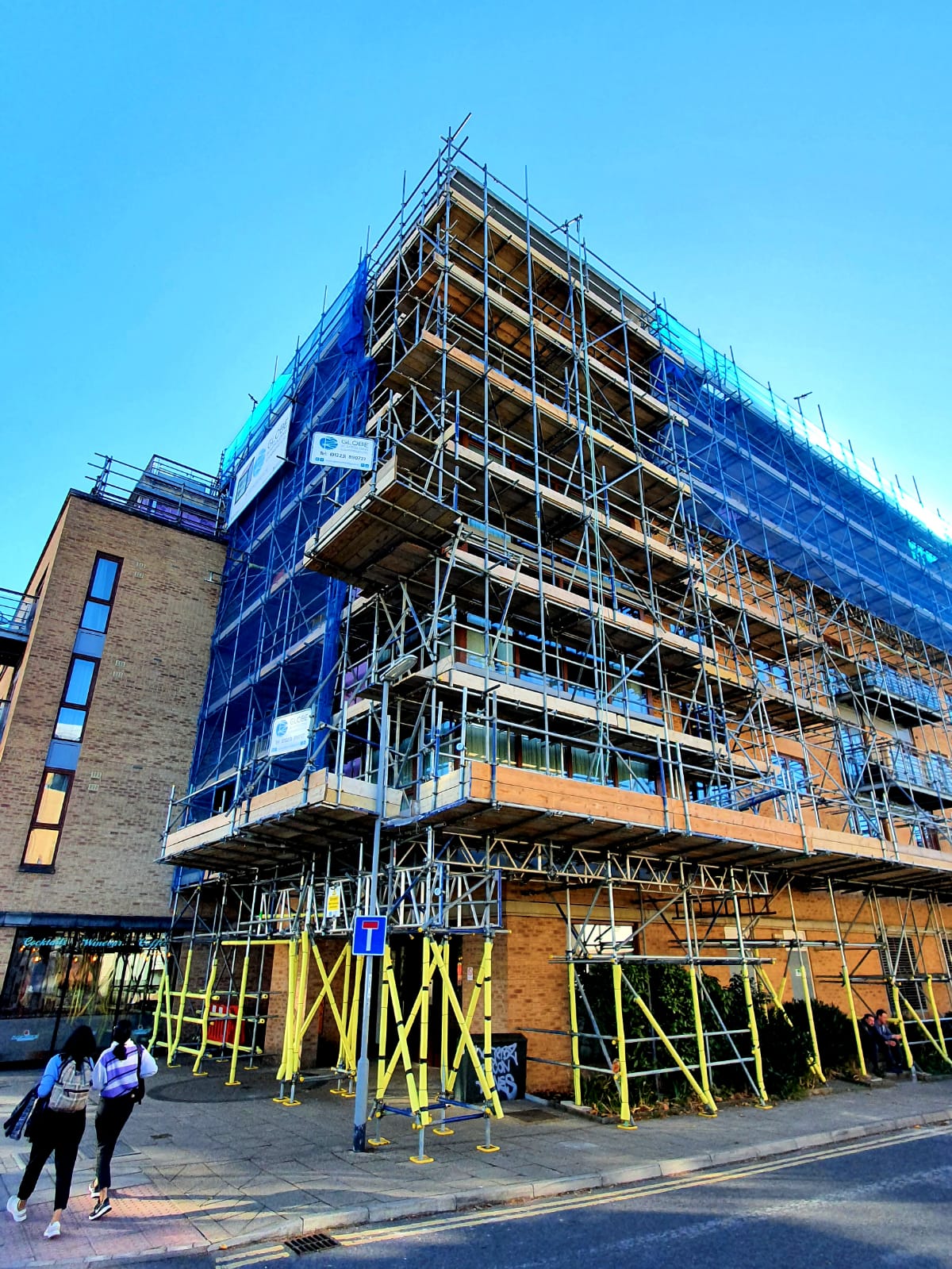
Once groundworks reach the required stage, Globe Cambridge mobilises the scaffold package. With more than 30 years of experience in Cambridgeshire and the South East, Globe Cambridge’s approach to scaffold on residential developments is built around programme — getting the right scaffold configuration in place at the right time to enable the trades that follow.
On sites where Globe Cambridge and Globe Roofing are both working, the scaffold specification is planned with the roofing programme in mind from the outset. Lift heights, access points, and platform configurations are agreed between the two divisions before erection begins, so Globe Roofing’s gangs aren’t working around a scaffold that wasn’t designed for them. That coordination — which on a site with separate, unrelated subcontractors would fall to the principal contractor to manage — happens within the group.
Globe Cambridge holds Constructionline Gold, CHAS Advanced, CISRS certification, and NASC membership. Signed scaffold handover certificates, load limit documentation, and a seven-day statutory inspection service give the principal contractor the documentation they need at each stage of the scaffold lifecycle.
Roofing Delivered to Programme
Globe Roofing works across new build residential developments and social housing regeneration — the two sectors where programme certainty and NHBC compliance matter most. Operatives are mobilised on a plot-by-plot basis, with pricing agreed per plot and the programme planned to maintain continuity across multi-phase developments.
The division’s accreditations — NHBC, LABC, Premier, and CHAS — reflect the compliance requirements of the housing developer market. NHBC inspections at mid-build stages are a standard part of the roofing programme, and the documentation Globe Roofing produces at each stage is designed to support those inspections and the sign-off processes that follow.
On sites where Globe Civil Engineering has completed the groundworks and Globe Cambridge has erected the scaffold, Globe Roofing arrives on a site it already has familiarity with — trades it already has working relationships with, and a programme that has been coordinated across all three packages from the outset.
Fall Protection Throughout
Red Safety Netting provides fall protection across construction sites nationally, with more than 20 years of experience and FASET accreditation — the industry’s recognised standard for safety netting contractors. On residential developments, fall protection is required throughout the roofing programme, and the sequencing of netting installation needs to be coordinated carefully with the roofing package to avoid obstruction while maintaining continuous protection.
Because Red Safety Netting operates within the same group as Globe Roofing, that sequencing is planned as part of the combined package rather than managed as a separate coordination exercise. Installation certificates and FASET-compliant documentation are produced for every installation, giving the principal contractor the audit trail they need to demonstrate CDM compliance throughout the roofing phase.
One Group, Across the Whole Programme
The practical value of the Globe Group’s structure for a developer or principal contractor is that the coordination across these four packages — the interfaces between groundworks and scaffold, scaffold and roofing, roofing and fall protection — is managed within the group rather than left to the principal contractor to mediate between unrelated businesses.
This is reflected in the Globe Group’s long-term relationships with developers including Vistry, Taylor Wimpey, Barratt Homes, Persimmon, Bellway, Redrow, Bloor Homes, Countryside, Wates, and Kier. These are demanding clients with rigorous pre-qualification standards and ongoing performance expectations. The Globe Group’s record of 449,280 accident-free hours and 97% on-time project delivery reflects consistent performance across all four divisions, across multiple sites and programmes simultaneously.
To discuss how the Globe Group can support your next residential development across groundworks, scaffold, roofing, and fall protection, contact us today.